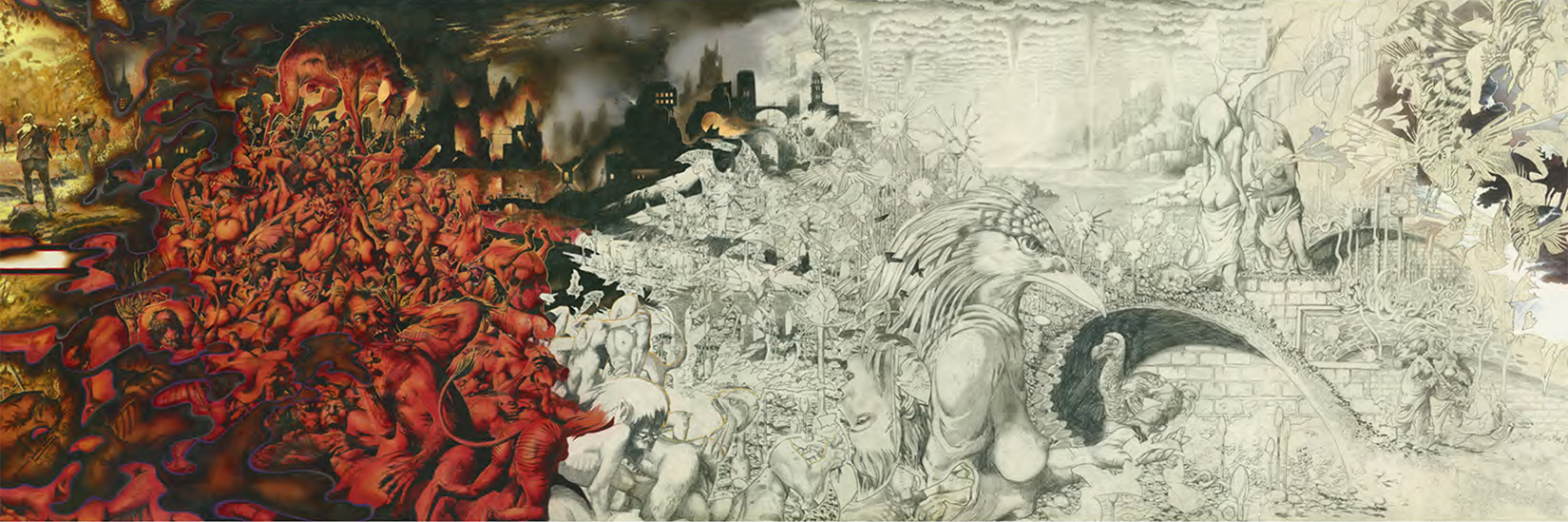


I have known Malcolm Mc Neill for almost 14 years, but I have known ‘of’ him for more than thirty.
The first time I saw Mc Neill’s name and an allusion to his extended collaboration with William S. Burroughs was in Eric Mottram’s 1977 study of Burroughs The Algebra of Need — but not quite, since his name appears as “Malcolm Neil.”1 I still have the copy that I must have bought in the early days of the 1990s. Mottram glosses Malcolm Mc Neill’s artwork for Burroughs’ short work The Unspeakable Mr Hart, which I had not seen at that point. He quotes from a Burroughs interview with Rolling Stone in which Burroughs describes, albeit briefly and without naming it, what Burroughs and Mc Neill called Ah Puch is Here; the title would only change to Ah Pook is Here late in the history of the work, and not without contention.
In those days, Mottram’s text on Burroughs was the Rosetta Stone. It also contained much on Wilhelm Reich, of whom I would write later. When I read Ted Morgan’s 1988 biography Literary Outlaw: The Life and Times of William S. Burroughs 2 I found that Morgan didn’t mention Mc Neill and hardly acknowledged Ah Pook is Here. But I remember how seductive that brief reference in Mottram’s book was to me in my early 20s. I did not yet know that the artistic relationship between the artist Malcolm Mc Neill and the writer William S. Burroughs lasted for seven years (and the personal relationship on and off for another thirty until Burroughs’ death in 1997), or that the oscillations between image/word had produced not a “comic book” or even “an illustrated book” but a profound statement of which the more than 100 pieces of art Mc Neill produced for The Unspeakable Mr Hart and Ah Puch is Here are testimony.
It is clear that even the scholarly Mottram was unaware in 1977 that Mc Neill and Burroughs had been working together for seven years. The working relationship and its results are obscure even to most Burroughs readers to this day. There will be time to analyze the reasons for that later, but they remain perverse, and ironically in the service of those processes—control processes—that Burroughs abhorred.
I cannot recall the precise circumstances, but somehow, I finally glimpsed some of Mc Neill’s art in 1993, when I was an undergraduate in Manchester, England. It made its uncanny return in 2011 when I learned that Fantagraphics was close to publishing the book that would be titled The Lost Art of Ah Pook is Here3 and with it Mc Neill’s essential memoir of the project Observed While Falling.4 The books were delayed. Unfortunately, the Burroughs Estate intervened to prevent the text and images from being published together as Mc Neill and Burroughs had intended, even through the compromised publication of a text-only edition of Ah Pook Is Here and Other Texts5 by Calder in 1979. Of this, more later. The definitive chronicle of the relationship between Mc Neill and Burroughs and the progress and obstacles to the work is best told in Mc Neill’s Observed While Falling.
But as the Ah Puch art resurfaced, I reached out to Malcolm Mc Neill to introduce myself and to tell him something of what the publication of his art meant to me, intrigued as I had been since that glancing reference in Mottram’s book. I found his email. We spoke on the telephone. We liked one another immediately and learned that we have a lot in common, not only as English expatriates, but in our views of art. He wrote a blurb for my second novel that came out in 2013, and has been deeply supportive of my writing ever since. Indeed, I would come to regard him as my crucial mentor. In 2018, I published Mc Neill’s science fiction graphic novel Tetra with my small publishing house Stalking Horse Press. In short, I have been close to the artist and the art, advocating where I could for this neglected and repressed work.
Now, it is my honor to be the archivist of the Mc Neill Archive, or the Mc Neill Burroughs Archive for convenient context; Mc Neill is an Emmy Award-winning artist and director with work beyond his collaboration with Burroughs that is not included in the ‘Ah Puch/Pook’ Archive which I maintain. My purpose here is to gradually unfold the process of preserving the Archive, to provide personal and scholarly insight into its contents, and to raise awareness of the work of my friend Malcolm Mc Neill. This has been a brief introduction to the Archive. There is much to say in the future.
– James Reich
- Mottram, E. (1977). William Burroughs: The Algebra of Need. Marion Boyars. ↩︎
- Morgan, T (1991). Literary Outlaw: The Life and Times of William S. Burroughs. Pimlico. ↩︎
- Mc Neill, M. (2012). The Lost Art of Ah Pook is Here: Images from the Graphic Novel. Fantagraphics. ↩︎
- Mc Neill, M. (2012). Observed While Falling: Bill Burroughs, Ah Pook, and Me. Fantagraphics. ↩︎
- Burroughs, W. S. (1979). Ah Pook is Here and Other Texts. Calder. ↩︎